Sejjil ballistic missile: development, capabilities and service history
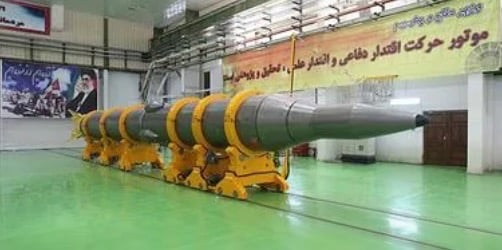
The Sejjil ballistic missile is a two-stage, solid propellant medium range ballistic missile (MRBM) domestically designed and produced by Iran. It is also known by several alternate transliterations, including Ashoura, Ashura, Sajil and Sajjil, reflecting variations in transliteration from Persian sources.
OSINTWEAPON RANGEMISSILES
Eduardo Domínguez Menéndez
3/15/20266 min read
Introduction
Within the Iranian missile inventory, the Sejjil (or Sejil or Persian سجیل, 'brimstone') represents a technological evolution from earlier liquid fuel ballistic systems by introducing solid fuel propulsion and a multi-stage configuration, both features significantly affect launch readiness and survivability.
The system is road-mobile and designed to deliver a single warhead payload against targets at ranges approaching 2000 km. Due to its propulsion type and operational characteristics, the Sejjil is often regarded as one of the most advanced missiles in Iran’s strategic arsenal.
First combat use in Third Gulf War
The Islamic Revolutionary Guard Corps (IRGC) announced the launch of the Sejjil missile on 15 March 2026 (Sunday). According to Iranian statements, the missile was fired as part of the 54th wave of “True Promise 4” operations.
What can be called as the Third Gulf War began on 28 February 2026, when the United States and Israel initiated a coordinated military campaign against Iran. The campaign, reportedly targeting Iranian leadership, air defense systems, missile infrastructure, and nuclear facilities, was conducted under the codename: Epic Fury by United States and Roaring Lion by Israel; the first strike resulted in the death of Iranian Supreme Leader Ali Khamenei and other senior officials, triggering a large-scale Iranian retaliatory campaign involving missiles and drones.
Within this context, the Sejjil launch, as previously said this is one of the Iran’s most capable ballistic systems, so it marks a notable escalation in the types of weaponry used.
Strategic reach: threat envelope for all the Middle East
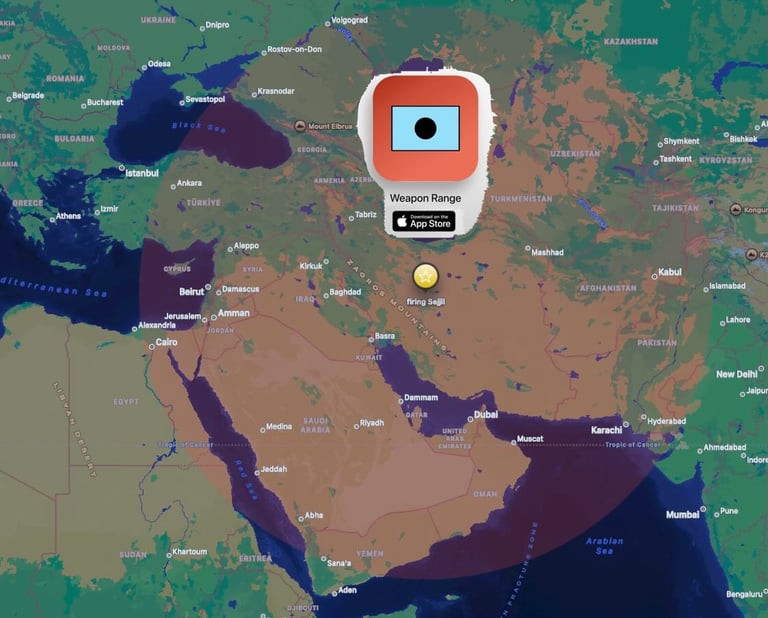
The Sejjil’s maximum reported range of approximately 2000 km places a wide geographic area within potential reach. If the missile’s range estimates are accurate, targets within reach may include: Israel, Cyprus, Turkey with its capital Ankara, all the Middle East (Saudi Arabia, United Arab Emirates, Oman, Irak, ...) and even Egypt with Cairo. To the East Sejjil might hit main cities of Pakistan: Islamabad and Karachi.
The ability of the missile to strike distant targets is further reinforced by its solid-fuel propulsion, which significantly reduces preparation time before launch.
Iran has claimed that a launch from the city of Natanz could allow the missile to reach Tel Aviv in less than seven minutes, illustrating the system’s potential for rapid strike capability.

Development and Technological Origins
Program background
Development of the Sejjil missile is believed to have begun in the late 1990s, drawing upon knowledge accumulated from earlier Iranian missile programs.
In particular, the project appears to stem directly from the Zelzal short range ballistic missile program, which played a major role in developing Iran’s solid fuel propulsion technology during the 1990s. Advances in solid fuel technology achieved during this period were critical to enabling the Sejjil’s propulsion system. The Zelzal development program is widely believed to have received assistance from China, which may have contributed to Iran’s growing experience with solid propellant technology.
Despite its similarities in size, weight, and range to certain variants of the Shahab-3 missile, the Sejjil represents a significant departure from that design due to its propulsion system to consider the Sejjil a more or less independent program with synergies from other programs.
Advantages over liquid fuel systems
Compared to liquid-fuel ballistic missiles such as the Shahab-3, solid-fuel missiles provide several operational advantages:
Shorter launch preparation times
Greater survivability before launch
Improved mobility and transportability
However, solid-fuel missiles also introduce engineering challenges. These include more complex guidance and control requirements due to the propulsion characteristics of solid motors.
How Iranian engineers addressed these issues remains unclear. It is possible that they adapted guidance technologies from the Shahab missile family or received additional foreign technical assistance.
Links to other missile programs
Influences from other Iranian missile programs
The Sejjil program is associated with several earlier or parallel Iranian missile projects:
Zelzal SRBM program, foundation for solid fuel propulsion development
Shahab-3 MRBM, earlier liquid fuel medium range missile with similar size and range characteristics
Ghadr-110
Samen
The Sejjil family is often considered a successor system intended to replace liquid fuel Shahab-series missiles.
Possible connections foreign missiles
While the Sejjil appears to be an indigenous design, speculation has occasionally linked the missile to foreign systems. Missiles sometimes mentioned in these discussions include:
Chinese DF-11
Chinese DF-15
However, the missile’s dimensions and performance characteristics differ sufficiently that analysts generally consider the Sejjil a distinct design rather than a direct derivative of these systems.
According to Uzi Rubin, former director of Israel's Ballistic Missile Defense Organization, the Sejjil does not resemble missiles from North Korea, Russia, China, or Pakistan, suggesting a significant advancement in Iran’s domestic missile engineering capability.
Rubin further indicated that the missile’s multi-stage configuration places Iran on a technological pathway toward intercontinental ballistic missile development.
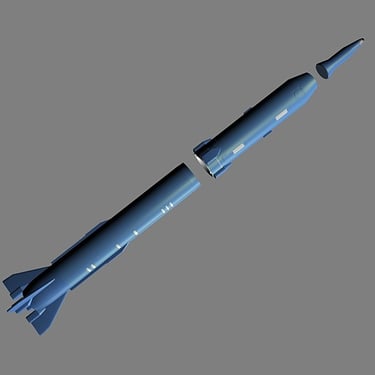
Technical specifications
Missile Type :Medium-range ballistic missile (MRBM)
Propulsion: Two-stage solid propellant
Launch Platform: Road-mobile
Length: 18 m
Diameter: 1.25 m
Launch Weight: 23,600 kg
Payload: around 700 kg
Warhead Types: High explosive (HE), potential nuclear
Maximum Range: around 2,000 km
Service Entry: 2012 (estimated)
Operators: Iran
The missile’s performance figures are believed to be based on a fuselage constructed from aeronautical grade steel, which influences the weight and range estimates.
The Sejjil is believed capable of delivering high explosive warheads, while future configurations could potentially carry nuclear warheads if such weapons were available.
Testing and operational history
The Sejjil missile did an initial series of flight tests during the late 2000s as Iran worked to validate the design and performance of its first domestically developed solid fuel medium range ballistic missile.
The first test launch occurred on 13 November 2008, during which the missile reportedly flew approximately 800 km. This initial flight demonstrated the viability of the two-stage solid propellant configuration and marked a significant milestone in Iran’s transition away from liquid fuel ballistic missile systems.
A second launch took place in May 2009, reportedly intended to evaluate improvements in guidance and navigation systems. Several additional tests were conducted between 2009 and 2012, bringing the total number of known flight tests to six. During the sixth test, the missile reportedly traveled approximately 1900 km, impacting in the Indian Ocean.
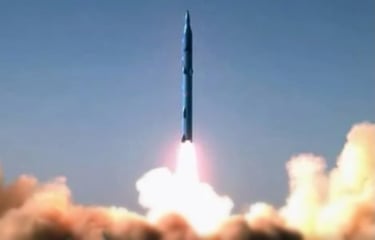
Following these early development trials, no further test launches were publicly reported for nearly a decade. This prolonged period of inactivity led many analysts to question whether the program had stalled or whether testing had continued outside the public domain.
The system resurfaced in January 2021 during Iran’s Great Prophet 15 military exercises. Footage from these exercises indicated the missile had likely received upgrades, including:
Ruggedised strap-down inertial guidance system: designed to withstand high vibration and acceleration during launch
Jet vane thrust-vector control surfaces adapted from the Ghadr missile, improving boost phase steering
These enhancements suggest improvements in flight stability, guidance reliability and trajectory control, although detailed specifications have not been publicly released.
Analysis of the footage indicated the possible integration of an improved guidance architecture, including a ruggedised strap-down inertial guidance system designed to withstand the high vibration and acceleration environments associated with solid fuel missile launches. The imagery also suggested the incorporation of jet vane thrust-vector control surfaces derived from the Ghadr ballistic missile, used to steer the missile during the boost phase by deflecting the rocket exhaust.
Variants of Sejjil
The designation Sejjil-1 was employed to early flight tests. Later tests labeled Sejjil-2. As development matured, Iranian sources and Western analyst increasingly used the unified name Sejjil, effectively subsuming earlier numbered test variants into a single system.
Operational employment of Sejjil
As a result, while the missile is generally assessed to have entered service around 2012, its current deployment status and operational readiness was uncertain but Iranian sources claim operational employment of Sejjil (till the moment of write this article (16 March 2026):
18 June 2025 – “Twelve-Day War” / Iran–Israel conflict: The IRGC reported firing a Sejjil missile at Israeli territory. According to Israeli sources, the missile was intercepted, and fragments caused minor damage to a vehicle. Some reports and analysis suggests that a missile strike on the Soroka Medical Center on 19 June 2025 may have involved the same system, although the type of missile impacting the hospital cannot be independently confirmed.


15 March 2026 – Third Gulf War: The IRGC announced the launch of Sejjil missiles as part of the 54th wave of “True Promise 4” operations against Israel, the use of this missile is not confirmed by IDF at the moment of write this article.
Sources:
https://missilethreat.csis.org/
Royal United Services Institute
Alma Research and Educational Center