Ghadr or Ghadr-110: Iran’s Medium-Range Ballistic Missile Most Likely to Reach Cyprus
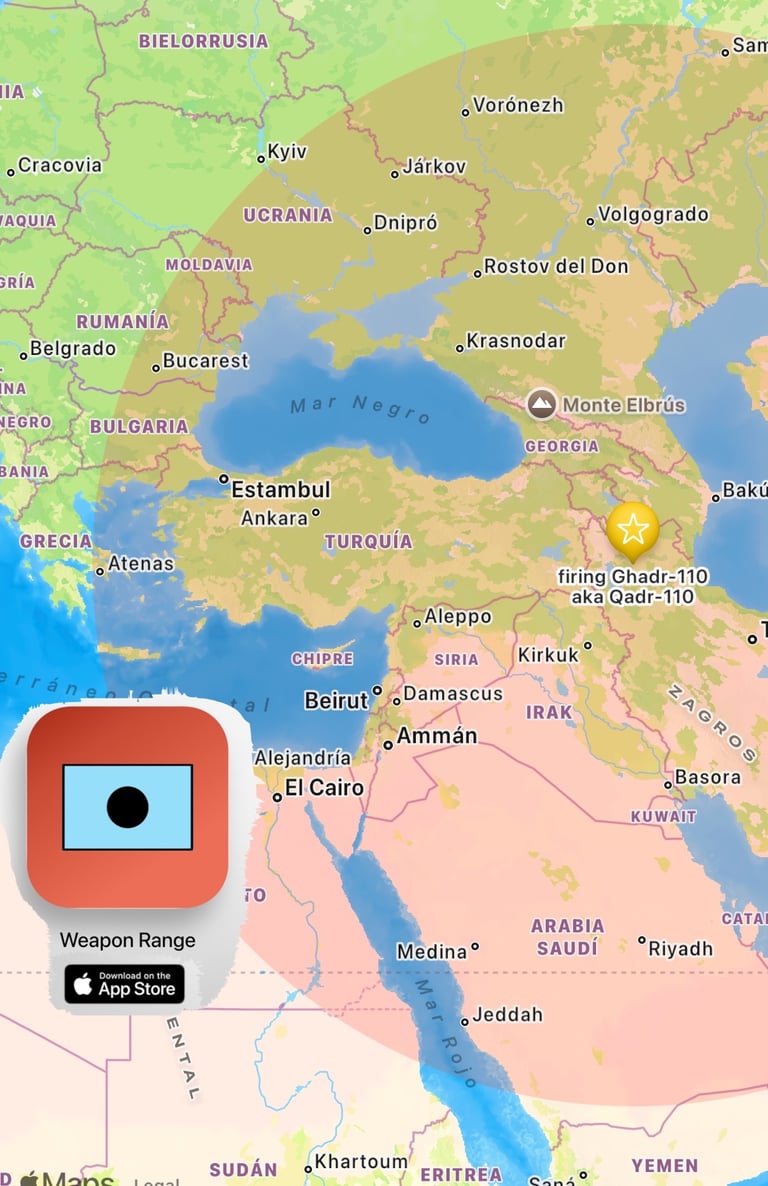
The Ghadr-110 (also spelled Qadr-110), sometimes quoted like Ghadr, consistently emerges as one of the most credible systems capable of striking distant targets such as Cyprus for many open-source analysis of Iran’s ballistic missile arsenal. It could also reach other parts of Eastern Europe like Greece, Rumania, Bulgaria, Turkey or Ukraine; including capitals and great cities like Athens, Ankara, Bucarest or Istambul.

Why Ghadr-110 Is a Realistic Candidate
Its range, mobility, operational maturity and documented use in regional operations validates it is feasible. The Ghadr-110 is classified as a medium-range ballistic missile (MRBM) with an estimated operational range of roughly 1,800 to 2,000 km, which covers Cyprus from most launch areas inside Iran without requiring forward basing. That reach is confirmed across multiple defense intelligence summaries.
Because it is a road-mobile, two-stage missile, it offers flexibility and survivability in contested environments. Its set-up time is significantly shorter than older Shahab-3 systems, reducing its vulnerability before launch. These attributes make it more suitable for use in large-area campaigns or sudden retaliatory strikes compared to heavier or more constrained systems.
Analysts have recorded Ghadr-110 launches in recent years, and strategic assessments commonly include it among the missiles Iran has employed in regional conflicts or deterrence messaging.
Clearing Up the Naming Confusion
Part of the difficulty in open-source and expert reporting on this system stems from how it is named in different contexts. Ghadr-110 is often referred to interchangeably as Ghadr-110, Qadr-110, Ghadr-1, Qadr or Ghadr (as shorthand for the family)
One source of misleadings is translating Persian to Latin alphabet has no single standard, so the same missile appears under different spellings. The Persian word قدر can be written as Ghadr, Qadr, Ghadar, Ghader depending on transliteration rules. And this affects many Iranian systems.
The most precise use of terms should be Ghadr-1 for the base missile and Qadr-110 for the series of the program designation and within the program exists variants that we will see lines bellow.
But on many sources, Ghadr-1 is often treated as the same missile, or the early designation of the Ghadr-110 system. Also When sources simply say “Ghadr missile”, they usually mean the entire Ghadr series
The safest way to think about it is that all these labels point to a family of MRBMs derived from a single program, not necessarily distinct products in every case. Misinterpretation of naming can lead to overcounting or false distinctions if this nuance isn’t applied carefully.
Variants Within the Qadr-110 Program
Iran has developed several variants of the Qadr/Ghadr missile, generally distinguished by range and payload:
Qadr S – Estimated range around 1,350 km
Qadr H – Estimated range around 1,650 km
Qadr F – Highest reported range, up to 1,950 km
These variants bridge shorter MRBM brackets and extend into the longer end of the medium-range category appropriate for regional power projection. All are believed to use a liquid first stage and a solid second stage, which is a hybrid design that gives a favorable range-to-weight balance.
Among these, Qadr F and the later blocks of the Ghadr-110 series are the most capable candidates for a strike on Cyprus, given their extended range and larger warhead options (up to roughly 1,000 kg).
Evolution: From Soviet Scud to Ghadr
Understanding the Ghadr family’s technical heritage gives important context for its capabilities. The lineage of Iranian MRBMs is a clear evolutionary chain:
Soviet R-17 Scud-B Heritage
The foundation of Iran’s ballistic program began with Scud technology, acquired via proliferation in the latter 20th century. These early designs were liquid-propelled and limited to short ranges.
North Korean Nodong / Shahab-3 Derivatives
During the 1990s and early 2000s, Iran incorporated Nodong-derived technology to produce the Shahab-3 family, extending range into the medium category (about 1,300-1,500 km).
Ghadr’s Hybrid Two-Stage Design
Ghadr represented a step change: merging a liquid-fueled first stage with a solid second stage improved range and reduced logistics footprint. The result was a missile capable of roughly 1,800-1,950 km—a significant jump compared to older systems. This is why Ghadr is often described as an “improved Shahab-3.”
The evolution reflects Iran’s focus on extending reach while improving launch responsiveness and survivability, key factors in any long-range targeting scenario.
Operational Role and Strategic Context
Iran’s ballistic doctrine emphasizes both deterrence and the ability to project power across regional theaters. Ghadr-110 sits alongside other systems such as Sejjil and Khorramshahr in Tehran’s layered strike capability. During recent conflicts, missiles from Ghadr variants have been documented in operational settings.
When analysts map Iranian ballistic arsenals geographically, Ghadr’s reach consistently envelopes locations like Cyprus and much of the Eastern Mediterranean, bolstering assessments that it is one of the few Iranian systems realistically able to engage such distant targets