Maisy Battery: historical guide for tourism with geolocated landmarks, research and reference
Located along the Normandy coast, the Maisy Battery was a key German position during Operation Overlord, controlling the mouth of the Taute River and supporting the defense of Utah Beach. Now it becomes an open air museum bearing the same name.
D-DAYOVERLORD NORMANDY GUIDENORMANDY
Eduardo Domínguez Menéndez
3/18/20264 min read
Maisy Battery components
The Maisy Battery comprised a coordinated network of German coastal fortifications, integrating artillery, infantry, and observation assets:
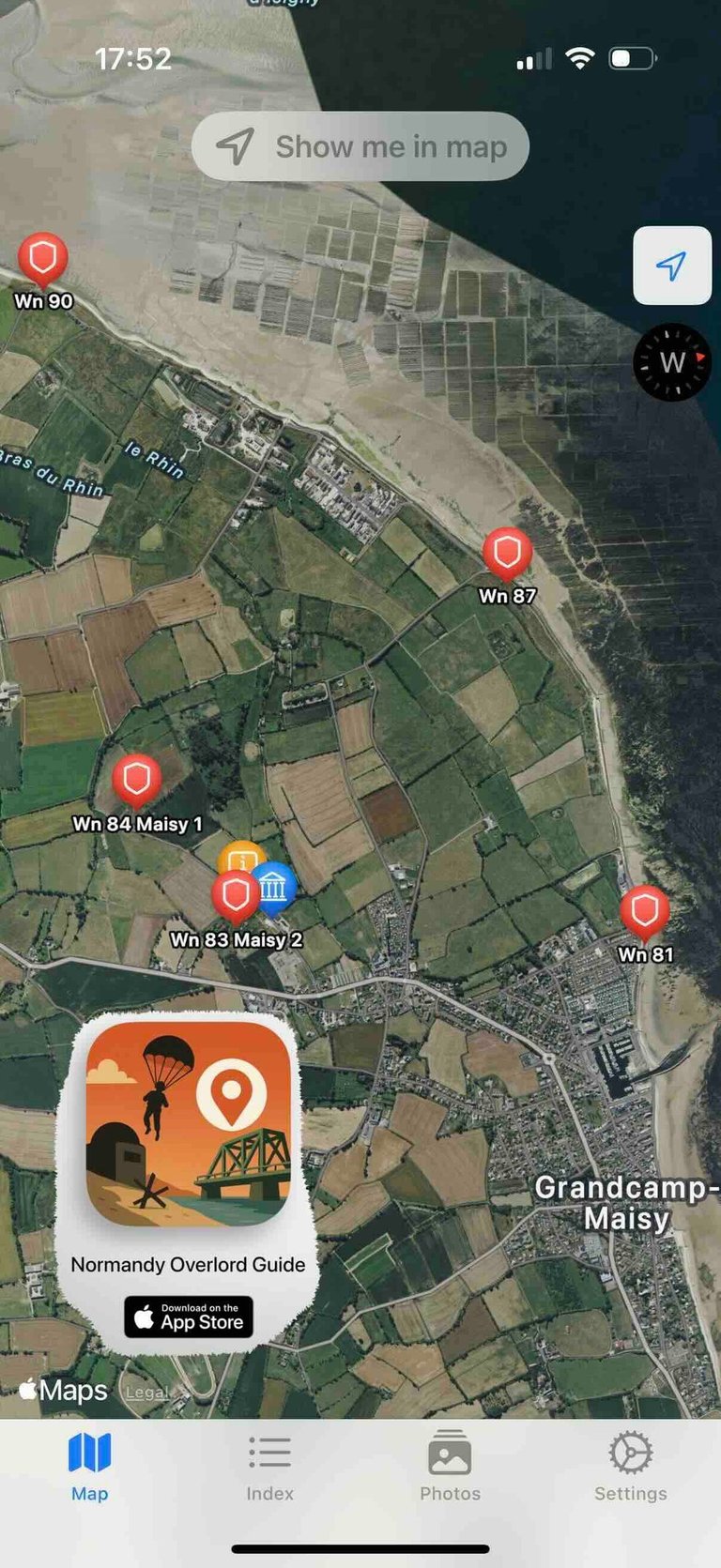
Wn 83 – Maisy 2 (La Perruque): Held by the 9th Battery of Artillery-Regiment 1716. The emplacement featured multiple personnel shelters, tobruk pillboxes and other facilities interconnected on a trench system. Its main armament included 155 mm Schneider Mle 1917 howitzers in barbette positions and 88 mm Flak anti-aircraft guns for air and coastal defense.
Wn 84 – Maisy 1 (La Martinière): Operated by the 8th Battery of Artillery-Regiment 1716, this strongpoint included H669 concrete casemates, tobruks, multiple auxiliary shelters, ammunition bunkers and an extensive trench and communication network protected by an minefield belt. Artillery consisted of captured 100 mm Skoda guns and a 75 mm AA gun.
Wn 87 – Command Post: Functioned as the artillery observation and fire control node for Wn 83 and Wn 84.
Wn 81 – Forward Observation Post (Fort Samson): Provided early warning, target acquisition, and forward artillery spotting. Defensive assets included mortars, machine guns and cm KWK L/32 direct-fire guns.
The battery’s defensive architecture combined fixed and field artillery, interconnected trench networks, fortified personnel shelters, observation posts, and engineered obstacles, exemplifying the tactical design of Atlantic Wall coastal fortifications.
For a more precise overview of the battery’s layout and discover exact quantities of main gun, their position (casemates or barbette), bunkers and explore the sites in detail: download Normandy Overlord Guide
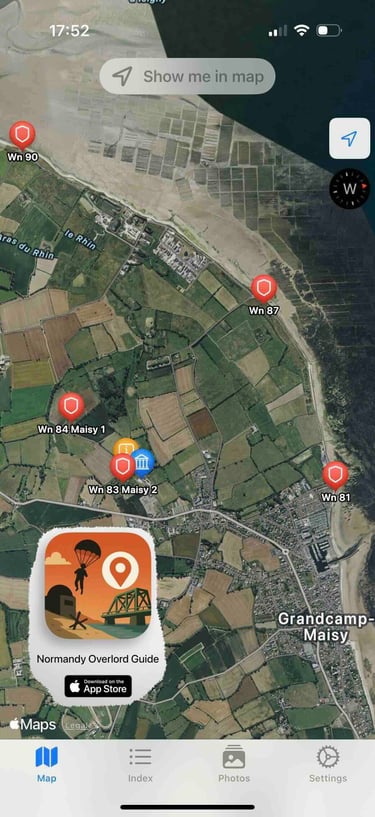
The next picture is an snapshot extracted Normandy Overlord Guide showing a satellite photo of all the area Maisy Battery and the exact geolocations of the strongpoints:
The Allied Assault of Maisy Battery
On 9 June 1944 (D+3), the 5th Ranger Battalion, United States Army, executed a coordinated assault on the Maisy Battery complex. The operation followed a structured preparatory and direct action plan:
Preparatory Fires: A suppressive bombardment targeting known artillery emplacements, personnel shelters and observation positions within Wn 83 and Wn 84.
Mortar Support: The assaulting forces received indirect fire support (107 mm mortars) to neutralise fortifications and disrupt defensive concentrations.
Infantry Advance: Rangers advanced under covering fire, clearing interconnected trenches, casemates, tobruks, and artillery positions over a 44-hectare defensive zone. The operation involved close combats within bunkers and tunnel networks, systematically reducing strongpoints.
Objective Secured: After approximately five hours of sustained engagement, Wn 83 and Wn 84 were secured. The capture eliminated German fire coverage over the mouth of the Taute River and removed a significant threat to Utah Beach landing operations.
The operation demonstrated combined arms coordination, integrating artillery suppression, mortar support and infantry assault tactics to overcome a well prepared fortified position.
For a more precise overview of the battery’s layout and discover exact quantities of main gun, their position (casemates or barbette), bunkers and explore the sites in detail, download the
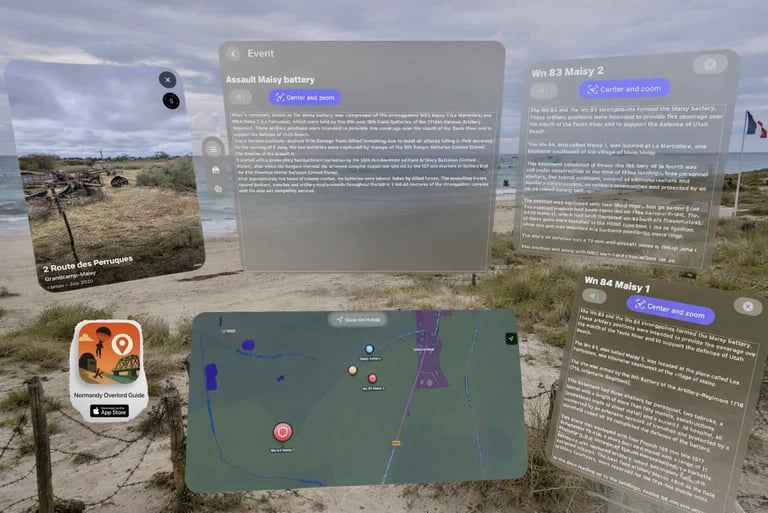
Follow the full story in detail the assault on Maisy Battery by 5th Rangers, know all artillery and support units involved in the combat downloading Normandy Overlord Guide The app is available for iOS (iPhone and iPad) and Apple Vision Pro, where you may take advance of spatial experience with multiple panels around you on an immersive way to deep in Normandy Maisy battery from your home or in your visit to Normandy.
Visit Maisy Battery museum today
Maisy Battery operates as an open air museum that allows you to explore the physical remains of a German artillery position integrated into the Atlantic Wall defensive network.
Situated on the Normandy coast between the sectors associated with the Utah Beach landings and the Omaha Beach landings, Maisy Battery is an important preserved German defensive complex connected to Operation Overlord.
One of the most distinctive features of the museum is the extensive trench system, where you can walk through approximately two kilometers of original German trenches. These trenches follow the historical layout of the defensive network and connect:
Several reinforced concrete bunkers
Artillery emplacements
Ammunition shelters
Command positions.
Moving through these passages provides a direct understanding of how the battery functioned as a fortified position protecting the coastline during the Normandy campaign.
For many decades after the war, the entire site remained buried beneath soil and dense vegetation, largely forgotten and inaccessible. In the early 2000s, the land was acquired by Gary Sterne, who initiated a long process of archaeological excavation and restoration. Numerous works were undertaken to clear unexploded artillery shells, uncover the trench network, and stabilize the concrete structures. These efforts gradually revealed the original defensive layout and made it possible to convert the location into a historical museum open to visitors.
The museum also exhibits a collection of Second World War military artifacts, not all of which were originally allocated to this battery. Visitors can observe artillery pieces installed in various firing positions, for example the German 10.5 cm leFH 18 howitzers (10,5 cm leichte Feldhaubitze 18).
In addition to ground warfare equipment, the museum houses a historic landing craft.
