LUCAS development and first use in combat
LUCAS (Low-cost Uncrewed Combat Attack System) is a drone of type loitering munition with an estimated range of 500 miles. It is inspired in philosophy and features on Iranian Shahed-136 drone also it's considered a copy with reverse engineering. As of the time of writing this article, the initial combat deployment of LUCAS is being speculated upon within the OSINT community during Operation Absolute in Venezuela, while the official confirmation of its use remains pending in this operation, it has already been confirmed by CENTCOM in the Third Gulf War against Iran on recent days.
OSINTWEAPON RANGEDRONES
Eduardo Domínguez Menéndez
3/20/20269 min read
Development
Presentation
The LUCAS drone, developed by the Arizona based defense contractor SpektreWorks, was showcased at the Pentagon courtyard as part of a demonstration of autonomous multi-domain systems at an event on 16 July 2025. Secretary of Defense (at that moment, now Secretary of War) Pete Hegseth personally reviewed the drone during this event at the pentagon, where eighteen other autonomous platforms were also shown.
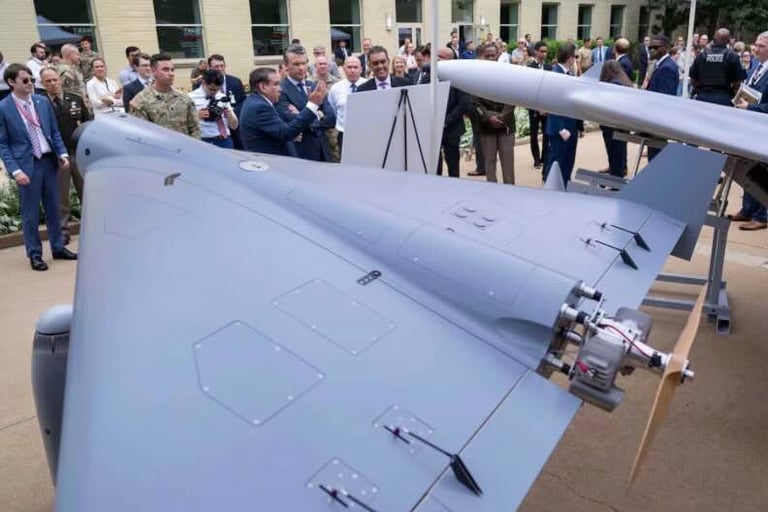
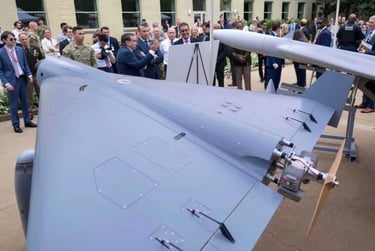
This unveiling comes amid a broader effort by the Department of Defense to equip U.S. and allied forces with scalable, attritable unmanned systems capable of supporting dispersed operations, particularly in the Indo-Pacific region; but as we well see lines bellow, the fast development granted get Initial Operational Capability soon its use in other theaters earlier... the Caribbean and the Middle East.
The introduction of LUCAS occurs in the context of a sweeping transformation in U.S. drone policy under the Trump administration’s July 10, 2025, memorandum titled “Unleashing U.S. Military Drone Dominance.” signed by Secretary of Defense Pete Hegseth and supported by Executive Order 14307.
The goal of this initiative is dramatically increase the pace of drone acquisition, reduce regulatory burdens and scale production of expendable systems. Under the new policy, Group 1 and Group 2 drones are reclassified as “consumer goods” or “expendables,” enabling them to be treated similarly to ammunition such as grenades rather than as traditional aircraft. Although LUCAS falls under the heavier Group 3 classification, the same principles are now being applied to accelerate its fielding in the combat units and battlefields.
Origins of LUCAS
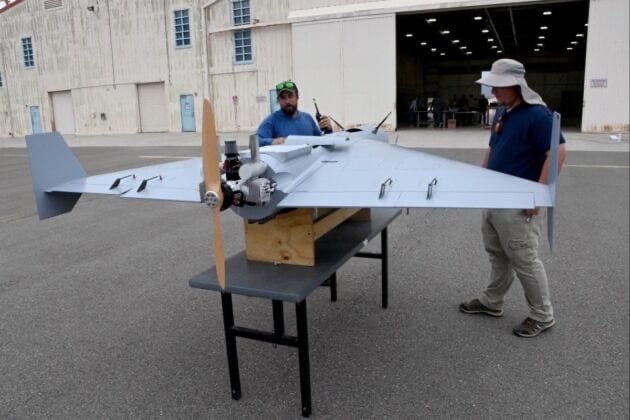
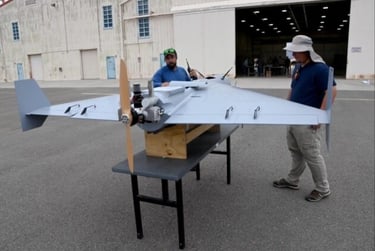
The LUCAS drone, officially known as the Low-Cost Uncrewed Combat Attack System, seems to be built on or derived from the FLM 136 target drone, this connection is given because FLM 136 target drone closely matching LUCAS’s size and configuration. This fact also generated some misleading and identification errors on the first days of the deveploment on the community.
SpektreWorks was one of the companies selected for the Army’s Applied Small UAS Prototype Innovation Transition (APFIT) program, which aimed to accelerate transition-ready drone systems into service. This program specifically emphasized attritable, modular and low cost designs for contested environments.
LUCAS technical specifications
LUCAS is classified as a Group 3 unmanned aerial vehicle, which means it may weigh up to 600 kilograms and operate at altitudes up to 5,500 meters.
The drone visually closely resembles Iran’s Shahed-136 for many a copy by reverse engineering, with a triangular wingspan of approximately 2.5 to 3 meters and a piston engine.
However LUCAS is quite different and with improvements on the rest of the system, with special remark on flexibility, digital control and integration within a broader American combat architecture and systems.
LUCAS implements an open architecture design to allow the use of modular payload bays. Hence, it can accommodate depending on requirements of assigned mission:
Reconnaissance sensors
Electronic warfare modules
Explosive charges
It supports 28V and 12V power supplie. It includes a payload network enabling remote switching of systems during flight.
Its launch methods include “truck based” deployment and “Rocket Assisted Take-Off” (RATO), enhancing flexibility for field operations without specialized infrastructure or crew training. Estimated weight at launch is the range between 70 to 100 kilograms.
LUCAS includes modular enhancements that support reuse in certain configurations, and its integration into the Multi-domain Unmanned Systems Communications (MUSIC) a network architecture developed by communications company Viasat to enable communication across various unmanned platforms. It is told that this network works as a mesh network allows it to serve not only as a loitering munition but also as a communication relay between unmanned systems and command centers. This specification was told in the first days of the public release, it might be adapted to use other communications systems at present given ist open and modular design.
SpektreWorks is the manufacturer. It is based in Arizona. It confirmed that the drone is capable of autonomous coordination with other platforms, making it suitable for swarm tactics and network-centric strike operations.
Lucas drone range
The consensus about Lucas drone range is 500 miles (800 Km) in a precision strike mission. This is not true always because LUCAS drone is multi-mission, it could reach around 1250 miles (2000 Km) depending on payload and mission profile.
The estimation of 500 miles is validated by Alex Hollings, host of Sandboxx News’ FirePower, who states he FLM 136 model (the precursor of LUCAS) carries a range capability of around 500 miles, with a maximum payload of 40 pounds (18.1 Kg). Realize that it is roughly twice the explosive yield of a hellfire missile.
But if we do LUCAS vs Shahed-136 comparison is payload mass. The Shahed drone typically carries a 30–50 kg explosive warhead and executes strikes 2000 Km deep inside enemy territory, even 2500 Km under certain circumstances. Due LUCAS is an upgraded copy we can asume its theoretical maximum range in optimum conditions is at least the same.
The range over 800 Km can be reachable easily due to its modular design, allows trades explosive weight for sensors or communications equipment. Types of mission
Surveillance and reconnaissance the payload type will be ISR sensors
Battlefield networking the payload type will be a communications relay
Precision strike the payload type is a warhead
The bottom line is that the weight of these sensors or the warhead will determine the range of LUCAS that goes from 800 Km is the standard attack role to around 2000 Km with a set-up to optimize range and endurance.
If you want to do your own range simulations, you can check the reachable targets of LUCAS on a strike mission from any place in the world with an interactive map with the app Weapon Range. It works like a calculator of the range for hundreds of missiles, drones and artillery systems.
Cost of LUCAS
The cost of the LUCAS drone has not been publicly disclosed, but the common estimation on press and OSINT was 35000 dollars at the moment of the release.
After own critical analysis, this cost seems to come from a Trump’s quote in a panel close to LUCAS drone in a showcase as you can see in the bellow photo
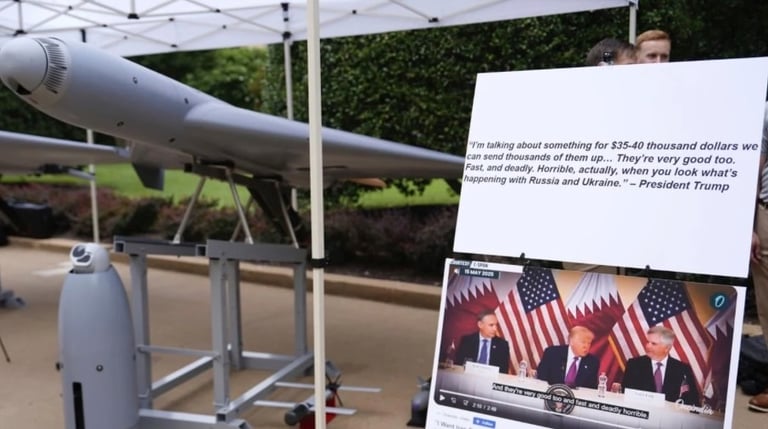
Trump's quote says:
“I’m talking about something for $35-40,000 dollars we can send thousands of them up... They’re very good too. Fast, and deadly. Horrible, actually, when you look what’s happening with Russia and Ukraine.”
Later December 2025, in an interview to TWZ Navy Capt. Tim Hawkins, a CENTCOM spokesperson told “Costing approximately $35,000 per platform, LUCAS is a low-cost, scalable system that provides cutting-edge capabilities at a fraction of the cost of traditional long-range U.S. systems that can deliver similar effects”
Although these prices points have established the cost for OSINT, it remains without fact-check accountability . However, analyzing the components inside LUCAS with sensors, all stuff related with integration with other platforms and communication harware, as well as other factors such as the cost of the United States labor workforce (this drone is intended to be manufactured in the United States) the 35000 dollars is more maximum goal propaganda than a feasible cost; and less without mass production at this moment (March 2026).
Mass Production
After publishing this article the confirmation of mass production appeared in the press and force to add this new section. The emerged reports, widely attributed to an initial scoop by Bloomberg, that U.S. authorities have decided to initiate mass production of the LUCAS system, following its reported operational success during Operation Epic Fury, as indicated by a senior Pentagon official.
Further examination of the source to determine whether the Pentagon statement was anonymous revealed or not I found that the remarks were in fact delivered by Emile Michael, Under Secretary for Research and Engineering at the U.S. Department of Defense, on Tuesday, 17 March, during a defense industry event in Washington, D.C..
His statement was: “The core idea is to mass-produce this drone in the United States and have the ability to surge production when needed.”
While cross-checking sources to validate this latest development regarding mass production, several specialized internet portals told that the unit cost of the LUCAS drone may reach up to $55,000, as noted by Ryan Finnerty in an article published by FlightGlobal.
Deployment
On December 3 2025, U.S. Central Command (CENTCOM) announced a new task force for the U.S. military’s first one-way-attack drone squadron based in the Middle East. , Task Force Scorpion Strike, to integrate LUCAS systems into combat operations in the Middle East. CENTCOM launched Task Force Scorpion Strike (TFSS) four months after Secretary of War Pete Hegseth directed acceleration of the acquisition and fielding of affordable drone technology.
TFSS is designed to quickly deliver low cost and effective drone capabilities into the hands of warfighters. The base the is deployed this unit wasn’t unveiled.
On December 16, 2025, a test where LUCAS drone was successfully launched from a vessel on a maritime environment for the first time. The launch happened from the flight deck of the Independence-class littoral combat ship USS Santa Barbara (LCS 32) while operating in the open sea in Persian / Arabian Gulf. Task Force 59 operated the LUCAS drone, which is part of Task Force Scorpion Strike, a one-way attack drone squadron recently deployed to the Middle East.
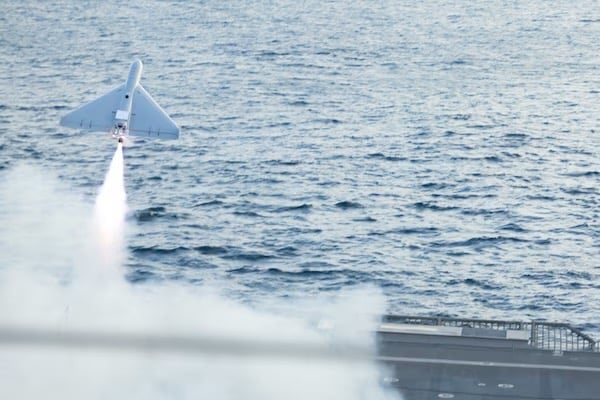
This demonstration confirmed that the LUCAS could be integrated into distributed naval strike concepts, enabling ships to deploy low cost long range attack drones. This new strike capacity of the US Navy strengths its power hit and increase its deterrence at low cost.
Use of Lucas in combat
Thought the official facts of initial deployment was in the Middle East Theater, the baptism of fire of LUCAS according to OSINT researchers based on videos of witness in Caracas identify a “Shahed-like” employed by US in attacks on January 3, 2026 during Operation Absolute Resolve. Drones were used in conjunction with missile strikes to swarm and overwhelm Venezuelan air defense systems in the successful operation to capture President Nicolas Maduro. US War Department has not officially confirmed the use of LUCAS drones in this operation (at least at the moment of write this article, March 2026).
LUCAS entered combat during Operation Epic Fury during the 2026 Iran War or Third Gulf War. On March 5 (a few days after the begin of the conflict), the CENTCOM commander, Admiral Cooper told the weapon was "indispensable", but declined to define its current targets in Iran.
Imaging how can be used in Operation Epic Fury
There isn't any official accountable information about its real use. Maybe we must wait weeks or months after the end of the war to know more real facts. Till this moment we can imagine how and where is used.
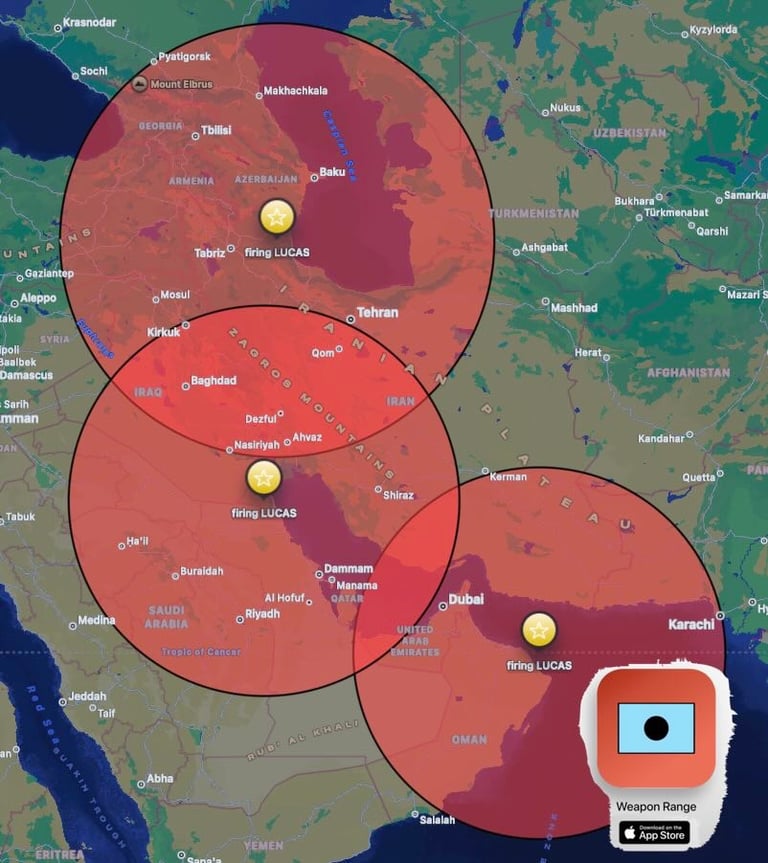
The following two pictures shows strike footprints with the estimated range of LUCAS (Low cost uncrewed Combat Attack System) on open sources of 800 Km. Each picture represent and scenario.
Lucas launch from a vessel in a Gulf of Oman
The first image illustrates the target envelope achievable if LUCAS is deployed from the Gulf of Oman. I chose this scenario because it is public that NAVCENT/C5F (United States Naval Forces Central Command / U.S. Fifth Fleet) already tested a LUCAS launch from a vessel; hence I consider is quire plausible.
This hypothetic scenario adopts a conservative approach for deep strikes into Iranian territory, assuming launch from a maritime platform positioned off the Omani coastline. The standoff distance from Iran is deliberately maximized to mitigate exposure to Iran’s A2/AD (Anti-Access/Area Denial) its panoply of anti-surface warfare capabilities.
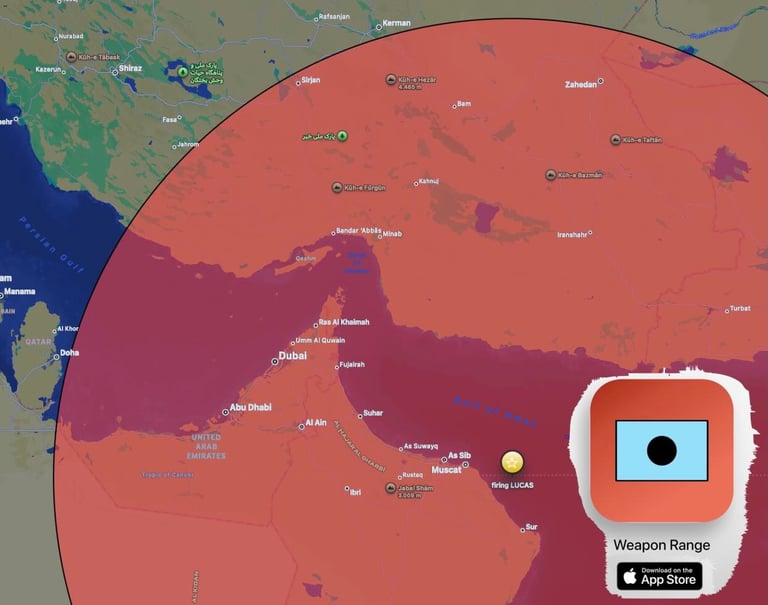
You may realize that all the Southern is on the engagement envelope. One important caveat is that it can reach the Strait Of Hormuz and its key naval base Bandar Abbas. In fact satellite image taken on March 2, 2026 reveals a intense attack with gollum's of black smoke; US authorities allege "10 Iranian ships have been “knocked out” so far".
Lucas launchs from a vessel in a Gulf of Oman, Kuwait and Irak (Erbil)
The second hypothetic scenario adds two new firing positions: Kuwait and Harir Air Base located in the Erbil Governorate, Kurdistan Region, Iraq. Now all Iran is reachable except the most Eastern central zone. Anyway key locations are cover like Tabriz, Tehran or Kharg Island,...

Sources:
U.S. Department of War
www.armyrecognition.com
The War Zone
Latest Updates:
This article is conceived like something live. The philosophy is adding new relevant info about the Lucas DRONE to get a final first class article with all document instead of generate several articles with new data dispersing the information.
First release
The version covered the announcement of LUCAS drone, the development, a critical cost analysis claim doubts about 35000 dollars cost and its use in combat. The first version of this article was released on March 17th.
First announcement mass production
The update incorporate the announce of Emile Michael (17th March) of intention to pass to mass production. Also a remark about the cost, some portals increase the price till 55000 dollars. The internet update was conducted on March 19th.
LUCAS range
A detailed analysis of the range of LUCAS drone taking into account the different missions. The internet update was conducted on March 20th.