Iran’s Khorramshahr Ballistic Missile: a development with Soviet and North Korean origins
The Khorramshahr likely derives from Soviet R-27 (SS-N-6 Serb) and North Korean Hwasong-10 (Musudan BM-25), though acquisition pathways: purchase or technology transfer or reverse-engineering are unclear
OSINTWEAPON RANGE
Eduardo Domínguez Menéndez
3/14/20265 min read
The technological baseline for the development of Iran’s Khorramshahr ballistic missile are the Soviet R-27 (SS-N-6 Serb) and North Korean Hwasong-10 (Musudan or BM-25 on export designation). Its current iteration Khorramshahr-4 can carry a 1500 kg payload with an estimated range of 1700 km, enabling it to target Israel, Turkey including its capital Istanbul. With a lighter warhead of 500 kg, its range extends to around 3000 km, reaching Southern and Eastern Europe, including Rome, Vienna, Poland, Bulgaria, Romania and more ...
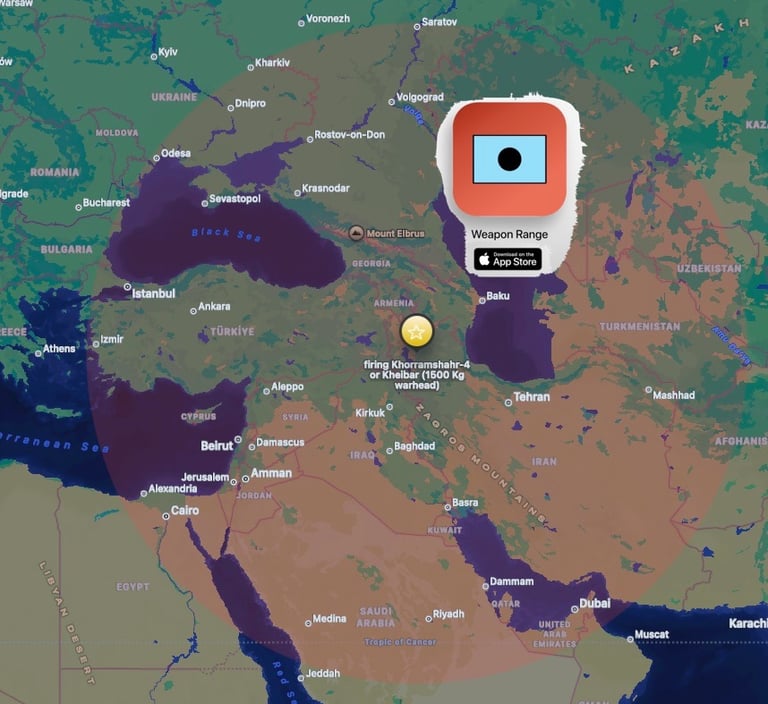
Download Weapon Range and make your own range checks of missiles and other artillery systems

Soviet technological origin: R-27 (SS-N-6)
The earliest technological ancestor associated with the Khorramshahr is the R-27 (SS-N-6 Serb), developed by the Soviet Union during the late 1960s for deployment on ballistic missile submarines.Such cooperation would fit a broader pattern of missile collaboration between the two countries dating back to earlier Iranian systems such as the Shahab series.
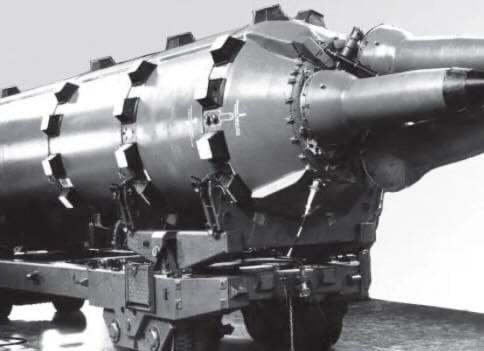
The R-27 was a single-stage, liquid-fuel submarine-launched ballistic missile (SLBM) designed for nuclear delivery. It introduced several technological innovations for its time, including lightweight structural tanks integrated into the missile body and compact, high-performance storable liquid propellants. These design features allowed a relatively small missile to achieve significant range.
R-27 technical specifications:
Range: approximately 2,400–3,000 km
Propulsion: single-stage liquid fuel
Launch platform: submarine
Payload: nuclear warhead
The missile’s propulsion system, particularly the engine and propellant tank arrangement, became a technological reference point for later missile developments outside the Soviet Union.
North Korean Hwasong-10 (Musudan / BM-25)
Other root missile is the Hwasong-10, also known in Western literature as the Musudan. It also called with the export designation like BM-25. This missile was developed by North Korea as a land-based intermediate-range ballistic missile (IRBM) and is widely believed to incorporate technology derived from the Soviet R-27.
North Korea reportedly began the development of the Musudan missile in 1992, when it formalized a contract with Russia’s Makeyev Engineering Design Office to produce an R-27-derived space launch vehicle. Allegedly, North Korea completed Musudan prototypes in 2000 and in September 2003, U.S. officials observed the first deployments of Musudan launchers at Mirim airbase near Pyongyang. The Musudan system entered North Korean service at some point between 2003 and 2008.
Unlike the original submarine-launched design, the Hwasong-10 was adapted for road-mobile land launchers, which required structural modifications and different operational procedures. It is believed North Korea used design information or engineering concepts from the R-27 to create a missile capable of longer ranges suitable for regional deterrence.


Hwasong-10 (Musudan) technical specifications:
Estimated range: 2,500–4,000 km
Propulsion: single-stage liquid fuel
Launch platform: road-mobile transporter-erector-launcher (TEL)
Payload: conventional or nuclear-capable warhead
Although the missile was displayed and occasionally tested by North Korea, its operational reliability has been debated due to a limited number of successful test launches.
Hwasong-10 (Musudan) link with R-27
Hwasong-10 (Musudan) uses a North Korean variant of the Russian 4D10 liquid-fueled rocket engine found on the R-27 SLBM. Fueled by more energetic unsymmetrical dimethylhydrazine (UDMH) and nitrogen tetroxide (NTO) propellants, the 4D10 offers enhanced performance over the kerosene-powered Scud and Nodong missile engines. This allows the Hwasong-10 (Musudan) to achieve ranges of 2500 to 4000 km without significantly increasing the missile’s size.
Iranian Development: Khorramshahr
The Khorramshahr missile is a liquid-fueled medium-range ballistic missile that it is heavily based on North Korea’s Hwasong-10 (Musudan) missile design. While its propulsion and general structure trace back to the Musudan, Iranian engineers have introduced significant modifications to match Tehran’s strategic and operational requirements. These changes include adjustments to range, payload capacity, type of warhead and reentry vehicle design; all these changes make the Khorramshahr a distinctly Iranian adaptation rather than a simple copy of its North Korean predecessor.
Iran unveiled the Khorramshahr missile in 2017. Going into the timeline of this year: Iran first test fired the missile in January 2017 and first publicly displayed it at a September 2017 military parade in Tehran.
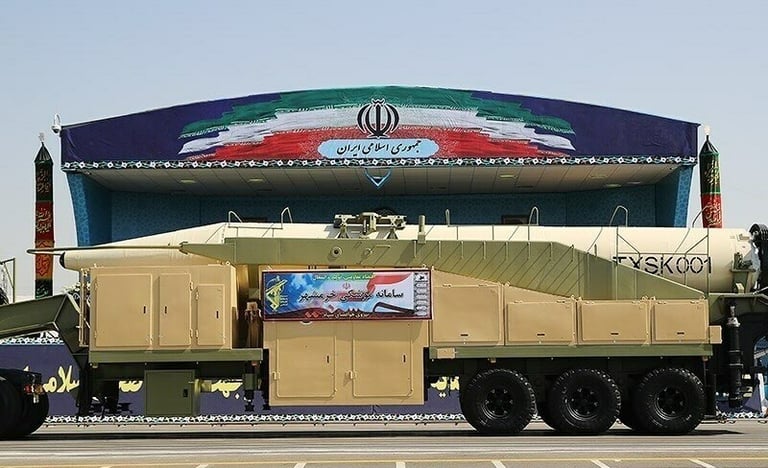
Khorramshahr technical specifications:
Range: trade-off with the payload, from 1700 km with 1500 Kg warhead to 3000 Km with 500 Kg warhead
Propulsion: liquid fuel
Configuration: single stage
Payload: large warhead capacity (max estimated up to 1500 – 1800 kg), conventional including cluster munitions. It is not clear nuclear warhead
The missile appears optimized for carrying heavier payloads rather than maximizing range, suggesting a design philosophy somewhat different from its presumed predecessors.
Controversy over Khorramshahr evolution from Hwasong-10 (Musudan)
The exact pathway through which Iran obtained the relevant missile technology remains contested. Three primary theories:
Direct procurement theory
One widely claim suggests that Iran purchased a number of North Korean Hwasong-10 missiles, sometimes referred to by the export designation BM-25, around the mid-2000s. Hence, North Korea transferred approximately 18 missile systems or components to Iran, which later served as the basis for domestic development.
Supporters of this theory argue that the similarities in engine configuration and overall missile dimensions strongly suggest access to complete missile systems or detailed design documentation.
However, the evidence for this transfer is largely based on intelligence assessments rather than publicly confirmed deliveries.
Technology transfer and collaborative development
Another explanation proposes that Iran did not necessarily receive complete missiles but instead benefited from technical cooperation with North Korea. In this scenario, North Korean engineers may have provided design knowledge, propulsion technology or manufacturing assistance.
Such cooperation would fit a broader pattern of missile collaboration between the two countries dating back to earlier Iranian systems such as the Shahab series.
Under this interpretation, the Khorramshahr would represent a jointly influenced but domestically produced system, rather than a direct copy of the Musudan.
Reverse-Engineering and Black Market Acquisition
A minority view proposes a different pathway entirely. According to this hypothesis, Iran may have acquired components or technical documentation related to the R-27 missile through international black markets, possibly originating from post-Soviet stockpiles.
These components could then have been adapted with North Korean technical assistance, allowing Iranian engineers to reconstruct or modify the design. This theory emphasizes Iran’s growing domestic missile engineering capabilities and suggests that the Khorramshahr could represent a partially reverse-engineered system rather than a direct derivative.
Although this explanation remains less widely accepted, it illustrates the uncertainty surrounding the exact transfer mechanisms behind the missile’s development.
Main different technical specifications between Khorramshahr and its predecessors R-27 and Hwasong-10 (Musudan)
Range and payload balance
The Khorramshahr ideal range is shorter (2,000 km) than the Hwasong-10 (Musudan).
This reduction may reflect a deliberate design choice to allow a heavier payload, potentially enabling multiple warheads or large conventional payloads.
Warhead configuration
Iranian presentations suggest the missile may be capable of carrying multiple reentry vehicles, a feature not commonly associated with earlier variants of the Musudan. The first analysis of March 2026 attacks report is used with cluster munitions.
Structural modifications
External differences in the missile’s nose cone and reentry vehicle design indicate possible aerodynamic and payload integration changes.
Operational doctrine
Unlike the submarine-launched R-27, the Khorramshahr is a land-based system, likely deployed on mobile launch platforms (TEL) for survivability.
Sources:
https://missilethreat.csis.org/
International Institute for Strategic Studies (IISS)
Royal United Services Institute
Alma Research and Educational Center